ZEDS Blog


I enjoy the essays of Dafoe, Addison, and Samuel
Johnson, all of which were published in pamphlets. Pamphlets were in vogue from 1650-1800, providing writers a forum to express views on politics, society, religion, and art. This has been revived in modern times in the form of blogs.

This is now a slight revamp of my blog that started in 2008.
My reading has become a little more specialized, although previous books commented on show I was heading this direction. At this point I will review mainly Christian texts or other texts from a Christian perspective. I intend to post more regularly with book reviews.

I consider reading and writing as part of the spiritual
journey toward maturity and, I hope, wisdom. These are postings of what I’m learning along the way.

Rod Zinkel, August 19, 2015


Saturday, August 31, 2019

Quick Reviews of Readings

As usual, I write for a time, then read for a time and do not post anything. I have not written essays of late, but I will write some impressions of books I've read, until I write something more substantial. So I will post some of these quick reviews here. Most are along the lines of Christian reading, though not limited to it. I encourage Christians to read, and not just Christian works. Just this month, as I teach Chip Ingram's book, Good to Great in God's Eyes, we are discussing great Christians read great books. So I'll post something of those great books as I come across them. I hope you might find something of interest. 

The Alluring Woman: Robert Girardi's novel, Vaporetto 13.


The novel takes place in Venice, and the setting is important to the story, as the city is sinking. The protagonist, Jack Squire, is an American currency trader abroad, sent to get the inside scoop on the frequently changing politics of Italy. Money is central because he deals in it; his pager keeps him up on money changes globally. In Venice he meets a mysterious woman, Caterina, who takes his mind off the money, because she knows there are more important things. She talks of bygone periods as though from first-hand experience, of days of the Barnabotti, of Paolo Sarpi, of political intrigue and assassinations and of tragedy In Venice. Squire is fascinated by the woman and her world, what little she reveals to him. He thinks of her to the point of neglecting all else. Their meetings are always at night, as she must catch the early-morning vaporetto (a water bus) back to the Lagoon. She is religious in her own way. She is cool in her manner. And she is private, so much so that Jack must spy out where she lives. She has only told him it would not be good for him to visit because she has an overprotective father who would not allow the relationship.
            
Girardi is excellent in developing the mysterious woman, giving enough to allure, as she does Jack Squire, and in building suspense by Jack’s obsession to find out who this woman is. The setting in Venice is beautiful, but also conveys the antiquated past eroding. Knowledge of something of the history of Venice, and a map, are helpful in reading, but not essential. 

Warning: there is some sexual content, some strong language.

Sunday, August 21, 2016

A Christian Perspective of a Liberal Arts Education - Book Review of Wisdom and Eloquence

Wisdom and Eloquence, by Robert Littlejohn and Charles T. Evans, describes a classical Christian education, which is to say a liberal arts education by a pre-twentieth century definition. The authors write of the importance of the trivium – grammar, dialectic, and rhetoric, with their emphasis on rhetoric, and the quadrivium – arithmetic, geometry, astronomy and music. The authors expand the quadrivium a little more widely than the classical definition, as they include geography and visual arts. They do not ignore math and science, and write of the Christian student’s need for these subjects. Science is not opposed to Christianity: “The overarching paradigm for a Christian education in the sciences is the understanding that our worldview embraces the reality that our study of the natural sciences is our window into God’s revelation of himself to his image-bearers through his creation” (124-25). The culmination of science is theology and philosophy, “toward which all our studies in the liberal arts has been building” (127).

While the book is largely the philosophy of education of the authors, they discuss practical methods of the classical education. These include:
1. In early and middle years reading should be a large portion of students’ studies, taught by three ways: students reading aloud, students reading silently, and teachers reading aloud from works that exceed the students’ reading level by at least two grades.
2. Schools should provide resources and opportunities for parents to teach their children ‘socializing subjects,’ like sex education.
3. Disciplines that rely on cumulative knowledge, like math or foreign languages, should be reviewed regularly, (weekly or monthly). Other subjects may be covered in a three-year cycle.
4. Every level of curricular planning should have objectives that are measureable, to which the school’s programs are answerable.

What are some the principles of the authors’ philosophy of education? They suggest the whole education of K-12 to have an objective, and with that end in mind to plan from the top – graduation – down. “We must look first to the desired end of the educational process, to the skills, knowledge, and virtues we want to be universally inherent in our graduates and determine how to get them there” (166). The Christian perspective must be kept in mind by educators: “We don’t produce these leaders (that is the work of the Holy Spirit), but we can encourage this potential by reminding ourselves and each other that all our students, whether they profess faith or not, are fashioned in God’s own image” (45). The authors go so far as to say the Christian school should have a Christian faculty:

A non-Christian teacher’s presuppositions, no matter how sympathetic toward or accepting he may be of Christian ethics, places him at odds with the Christian worldview, especially in metaphysics (one’s understanding of why and how things exist) and epistemology (one’s understanding of how we can know what we know). This is an unacceptable conflict that renders the Christian school’s mission ineffective and hypocritical. So, Christ must be the central reference point of the teacher’s life in a way that recognizes him as the active and irresistible Creator, Ruler, and Redeemer of the universe. The Christian teacher must also be committed to placing the welfare of others ahead of his own.  (157)

Sunday, August 7, 2016

An Intimate Autobiography - Review of C. S. Lewis's A Grief Observed


C. S. Lewis’s A Grief Observed is the kind of book that some will value for the personal expression of grief, and relate to it, in the same way those in love appreciate expressions of love. Apart from that, I think the interest will be for those who study Lewis to know more about the author. While he observes his own grief with language that at times is detached [example], perhaps reflecting his consideration of God as one conducting experiments on humans [quote], the book is an intimate autobiography, albeit of a brief time.

The intimacy develops in several ways. The writing is not typical of Lewis, as it is about himself, about his feelings, at times unchecked by reason. For instance, in one journal entry Lewis writes, “Time after time, when He seemed most gracious, He was really preparing the next torture.” Lewis admits, in the next journal entry, “I wrote that last night. It was a yell rather than a thought.”

There is intimacy in the form of journal entries. Journaling was a form of writing Lewis had practiced many years before, at the behest of Mrs. Moore, and eventually quit for its self-indulgence. Lewis realizes this again when he writes in one entry late in this account, “The notes have been about myself, and about H. [Joy], and about God. In that order. The order and the proportions exactly what they ought not to have been.” Later entries show the proportions do not remain this way. It may be that with some resolution of the grief he quits the journal again, as it seems the resolution has only begun when the book ends.


Monday, May 30, 2016

The Christian Tradition of Art

Titus Burckhardt holds to a traditional approach to Christian art because Christian art requires it. "For this very reason traditional symbolism is never without beauty: according to the spiritual view of the world, the beauty of an object is nothing but the transparency of its existential envelopes; an art worthy of the name is beautiful because it is true." (Locations 136-138 Kindle version) Burckhardt expresses a premodern view of art (Medieval), as opposed to a modern view (Renaissance and after). In the former the truth of traditional symbolism is important; in the latter individual expression is important.
          One of the most tenacious of typically modern prejudices
     is the one that sets itself up against the impersonal and
     objective rules of an art, for fear that they should stifle
     creative genius. In reality no work exists that is traditional,
     and therefore 'bound' by changeless principles, which does
     not give sensible expression to a certain creative joy of the
     soul; whereas modern individualism has produced, apart
     from a few works of genius which are nevertheless
     spiritually barren, all the ugliness—the endless and
     despairing ugliness—of the forms which permeate the
     'ordinary life' of our times.  (Kindle Locations 146-150)
In the first essay, “Introduction to the Sacred Art of Christianity,” and the last essay, “The Decadence and the Renewal of Christian Art,” Burckhardt writes of the differing perspectives, and the loss of the sacred in the modern one.

The second essay, “The Role of Illuminated Manuscripts in Christian Art,” introduces the reader to several important manuscripts, such as the Book of Kells, the Book of Durrow, early Northumbrian manuscripts, early Syrian manuscripts, and the Ambrosian Illiad. The author writes of the style of illumination and the cultures these books came from.

The title essay, the longest, is more technical than the others. Burckhardt discusses the art of the icon, architecture, and what these represent; medieval philosophy, mainly from Aristotle, but also from Plato and Boethius; and art of Eastern Orthodoxy. In this essay the author includes specific examples of each art.

As these are essays, and the topics significant, the book is a rather broad overview, far from comprehensive. Aptly, the author’s writing is significant. In writing a review there are many quotations I would have liked to have included. Burckhardt’s words have the weight of someone who knows religion and art, both of which use the language of man’s nature and the timeless.

P.S. In the last essay, “The Decadence and the Renewal of Christian Art,” the author addresses the question of whether Christian art can be renewed or reborn. He makes two separate statements:
          But a renewal of Christian art is not conceivable without
     an awakening of the contemplative spirit at the heart of
     Christianity; in the absence of this foundation, every
     attempt to restore Christian art will fail; it can never be
     anything but a barren reconstruction.  (Kindle Locations
     1461-1462)
"Christian art will not be reborn unless it completely frees itself from individualistic relativism, and returns to the sources of its inspiration, which by definition are situated in the 'timeless.'" (Kindle Locations 1497-1498)

Sunday, May 1, 2016

A Christian Approach to Literary Criticism


Leland Ryken’s book is the first I’ve read that prescribes a Christian approach to literature for critics and scholars to consider. I’ve read books on a Christian approach to aesthetics and the arts, and books that state the Christian perspective of certain works of literature, but this details what the Christian critic should consider specifically of literature, and all literature.

Leland Ryken has been writing on Christianity and literature for many years. This is an early book, published in 1979. Ryken has always looked at literature and theology side-by-side, as this book bears out. It is notable that this dual concern means Ryken’s is not solely the literary critic’s nor the theologian’s. The approach should not be assumed to reflect a moralistic, shallow reading of literature, as some may expect of an evangelical teacher. Nor is it such an aesthetic reading that the value of the art itself matters above the Scriptures and the Christian worldview. Ryken calls for reading of literature, even what may be called secular, and to evaluate it theologically as well as aesthetically.

Why should the Christian read literature, including secular? Ryken answers why anyone should read literature:
     1.      It presents human experience for our contemplation.
     2.      It offers itself as an object of beauty for our artistic contemplation.

The reasons, more specifically, to read of human experience:
     1.      It may express an experience the reader has had, in which case the author is our representative, expressing our feelings and values.
     2.      It may express an experience the reader has not had, in which case we may enlarge our being.
     3.      It provides material and occasion for recreation and enjoyment.
     4.      It leads to an understanding of human experience.
     5.      It confirms the uniqueness of man.

The Christian should read literature to learn worldviews, including those not his or her own. This is always a challenge. (I think the repeated topic of public discourse of late makes it a challenge to everyone, not just Christians.) One must be able to consider other worldviews, if only to relate to one’s own. Considering is not adopting.
          Literature presents a variety of world views for the
     reader’s analysis. Contemplating these serves the function
     of leading readers to evaluate, exercise and expand their
     own values and world view. Literature in this case is a
     catalyst for thought and a stimulus to the clarification of
     values. (102)

Why should the Christian critic know theology, more specifically, the Bible? Ryken advocates reading the Bible as literature, so to read it is to learn of literature. From the bible one learns about its genres – poetry, narrative, epistle, etc.; aspects of each genre in itself – form, rhythm, variety in unity, style in narratives; the use of archetypes; the source of allusions to the Bible.  Ryken suggests three uses of the Bible for the literary critic:
     1.      Using the Bible, rather than doctrine, to represent Christianity.
     2.      Using the biblical phrase or aphorism to help interpret literature.
     3.      Using the Bible to answer questions of literary theory.

This is not to say that every biblical approach to literature is a good one, in terms of topics. He writes of the ineffective effort by a critic to link Macbeth to the story of Cain and Abel, as the biblical story does not “help us to see meanings in the play that would otherwise remain obscure…” (214).

Why should the non-Christian read this book? Ryken clearly knows literature, and values it as such, not merely using it as a tool for teaching the Christian world view. In the chapter Literature and the Quest for Beauty, the author puts forward his structuralist approach, influenced by C.S. Lewis and Northrop Frye. He writes of the value of beauty in the Bible (as literature). He writes some literary critiques, mainly of form, of Psalm 1, Milton’s Sonnet 19, and e.e. cummings’s “In Just—“. Ryken writes of different levels of reading/enjoying a story: reading for plot, entering the imagined world, quality of experience, characterization, and archetypal pattern.

This book has become a personal favorite, particular to my interest in a Christian approach to literature. Chapter five, A Christian Approach to Literary Criticism, is, by itself, outstanding. I would use it for curriculum for any student of Christianity and literature, as it includes teaching on how to write on the subject.

Wednesday, March 2, 2016

Learning from Experience (The Book of Acts, not of Readings)


On February 21, 2016, I became a member of Green Bay First Assembly of God. I had started attending regularly seven months prior. Prior to that I attended sporadically for a year; prior to that maybe five times in eleven years. In that long time of little contact I continued in my faith, learning from books instead of pastors or others. I preferred this at the time because I had been a part of a church for many years, and saw the message from the pulpit always a letter to the unsaved or the laity. At some point I concluded I was not learning, so I turned to Christian books, not so much inspirational or motivational, as that was what sermons were, but informational books. I would read books used to educate the ministers.

Studying historical/cultural contexts of the books of the Bible, the Bible as literature, theology, apologetics, hermeneutics, etc. was beneficial and continues to be, but now in addition to church interaction and membership. (I write of both interaction and membership so the latter is not seen as simply being on the roll or being a financial supporter.) For the last couple of years, in reading Christian texts, I frequently came across statements of the importance of being a part of the community of the church, both the universal and the local. Authors who emphasized intellectual development – the sort of book I most often looked for – emphasized the need for the church too. The Christian intellectual, a term some will consider an oxymoron, either because they think Christians refuse to learn, or because they think the intellectual is necessarily proud, counters both expectations by valuing knowledge as a tool with which to serve and humility as a necessary check to what can become self-serving. I was lacking the humility to the extent that I did not participate in the local church.  

While I read Christian texts I also read the Bible. I was reading through the Bible in a year and experienced the timing of God (Christians will know what this means). After I regularly attended Green Bay First I read the book of Acts. At the same time I considered how I might participate in ministry at some small level. A class on church membership followed shortly after.

In the book of Acts we see the beginning of the Church. The followers of Christ are gathered in an upper room in Jerusalem, where Jesus had instructed them to wait for the gift his Father promised. They were together on the day of Pentecost when “the sound like a violent wind came from heaven and filled the whole house… they saw what seemed to be tongues of fire that separated and came to rest on each of them. All of them were filled with the Holy Spirit and began to speak in other tongues as the Spirit enabled them” Acts 2:2-4. With the Holy Spirit they declare the wonders of God, but in languages they did not know. It is others in Jerusalem, who spoke these languages, who testify this is what they spoke of. Others accuse them of being drunk. This miracle gets some attention, perhaps initially unwanted by those in the upper room since this is not long after Jesus is crucified. But the Holy Spirit gives them courage, and boldness. Peter steps up to address the crowd. In no uncertain terms he tells the audience they have crucified the Son of God, but also that God has raised Jesus rom the dead. When Peter is asked by members of the audience what they should do now, he replies, “Repent and be baptized, every one of you, in the name of Jesus Christ for the forgiveness of your sins. And you will receive the gift of the Holy Spirit. The promise is for you and your children and for all who are far off – for all whom the Lord our God will call” Acts 2:38-39. Many believe. After this event Luke writes that they – the believers, the church – devoted themselves to the apostles’ teaching, and to fellowship, to the breaking of bread and to prayer (Acts 2:42).  

I include this portion of Acts because this was what I read at just such a time that I saw growth in my relationship with God. I had to consider going beyond attending church services, with the rewards of fellowship, to church membership, with the rewards of commitment. Reading the book of Acts – the whole book – encouraged me to membership by showing me what the church should be. It is a place for learning from Scripture and teachers, for prayer and worship, for communion and meals together, for friendship and family, for encountering God. Read the book of Acts and you will get a sense of excitement about the Church, its vitality.

This is not to say it is perfect, or without challenges. Acts also shows how the Church experienced persecution from outside. Paul’s letters to local churches show how they experienced conflicts within. But in the early Church particulars, like style of worship, the comfort of the places they gathered, who was there or who was not, were not so important. Apart from some notable people, (who were notable for how God used them), these particulars are not given. We read “The believers were together and had everything in common. They sold property and possessions to give to anyone who had need” Acts 2:44-45. We do not read how impractical a tithe is or how talk of giving is tacky. We read that the believers came together for a meal and Paul talked until midnight, (Acts 20:7). We do not read how uncomfortable the chairs were.  

I originally found a substitute for church because I found a certain kind of learning in the conversation of books. I still find useful knowledge there. But I always knew I would return to the Church at some point, some point of contact. Acts gives an account of what was learned by experience in the Church, but why not experience it myself by being part of the Church?


Monday, January 11, 2016

How Reading the Bible Led to Reading Literature


After twenty-some years of studying literature it is only recently I started to study hermeneutics, which is the subject of interpreting texts, specifically the Bible. It is only in the last five years that I started to read Christian texts beside the Bible, (except C. S. Lewis’s writings for the love of the author, not for commentary on Scripture). I was content to read the Bible devotionally, that is, for personal edification and application. It was something to read, re-read, and meditate on. I still read it devotionally, as think it is fundamental to relationships with God, the Church, and the world. But I had not really studied Scripture; that is, looking at information about authorship, historical/cultural context, the English translations, etc. It is strange that I had done this kind of study of literature, but did not apply it to the Bible. What prompted the change was readings about integrating Christianity and non-ministerial professions, and books on Christian approaches to literature. These readings helped me to see the separation of the sacred and the secular interests was not so necessary nor so wise.

I graduated from college in 2004, a non-traditional graduate at age thirty-seven, (I’ve always been a little late to pick things up), with a Bachelor’s degree in English. I studied the subject for interest in it, for love of it. This actually stemmed with reading the Bible devotionally, starting at age nineteen. From reading the Bible devotionally I learned what could be learned from literature – wisdom. I did not treat all literature as a sacred text, but each text is someone’s knowledge, someone’s perspective, someone’s interpretation, and might be considered to represent the worldviews of others, views to which to relate Christ. Since wisdom does not refuse counsel, these other voices should be considered when making decisions, even if I disagree with the view.

My story is, in a way, the opposite of C. S. Lewis’s. Lewis was a student or teacher of literature, especially medieval literature, all his life. He was an atheist until age thirty-three. For some time he was well read in Christian texts, since the subject of medieval literature was commonly Christianity, and the perspective was that it was the truth. But Lewis did not see this truth himself. In his autobiography, Surprised by Joy, Lewis writes of how reading of Norse mythology had given him glimpses of what Christianity entailed. He came to realize Christianity was the myth that is true (p. 235, Houghton Mifflin Harcourt). For me, knowing how the text of the Bible could reveal much, not only about God, but about myself in relation to God, and what I consider to be God’s revelation of the desire to learn, I sought to read other works too. I believe this was God’s revelation – this desire to learn – because it was a turn-around. Through high school I read little; I could have been a good student but chose not to. Immediately after high school I certainly was not college bound. During the five years between high school and my eventual admission to college it was the study of the Bible that stirred the desire to read, to know more, to seek wisdom.

Sunday, November 15, 2015

Living With a Practical Brave Heart


Living the Braveheart Life is a motivational book by Randall Wallace, the writer of the film Braveheart. In this book he describes the characteristics of and actions taken by the ‘braveheart’, a way of living for every person. William Wallace, the historical figure of the film, and the film itself, illustrate this way of living, marked mainly by courage. Much of the book is autobiographical, illustrating the universals with his personal experience. Wallace writes of relationships, especially his relationship with his father. (This is reflected in the film, though briefly. In the book Wallace is able to expand on it.) He also writes of his relationship with his sons, mother, wife, colleagues.

Those who like the film may take an interest in Wallace’s thoughts behind the story – on the figure of William Wallace, the relationships between characters, etc. – and some of the circumstances in Wallace’s life he associates with the film.  

Overall the book’s theme is what a braveheart is and does. The braveheart life includes fitness, ignoring pain but acknowledging wounds, always learning and teaching, loving of stories, embracing mystery, living a lifelong campaign. It is not a hard heart. It is a “crucial point” to Wallace’s philosophy that “the heart that is brave is not ours; it is God’s” (182).   

Reading this just after reading a chapter of Ravi Zacharias tells me how motivational and inspirational books are similar, but may connect better than other books with certain demographics, based on the metaphors and images the authors use. The chapter I read of Zacharias’s book, The Grand Weaver, will connect, in part, because of the exotic culture of India he uses, (exotic being foreign or alien to Western readers). It will also connect with those who take interest in arts and crafts, as Zacharias uses the details of intricate rug-weaving to illustrate points. Living the Braveheart Life is likely to connect with different demographics, most likely with men. Both books offer good reading for Christians.

Sunday, October 11, 2015

The Theology of Work: Timothy Keller's Every Good Endeavor

In Every Good Endeavor Timothy Keller writes of the theology of work – all work. Vocation is not defined as a profession or position, such as ministry; a calling may be to any job. “A job is a vocation only if someone else calls you to do it for them rather than for yourself. And so our work can be a calling only if it is reimagined as a mission of service to something beyond merely our own interests” (19). The theology of work helps us to reimagine this mission, and that is not to say we delude ourselves into thinking our work as a mission when it is not. Keller writes, “If the God of the Bible exists, and there is a True Reality beneath and behind this one, and this life is not the only life, then every good endeavor, even the simplest ones, pursued in response to God’s calling, can matter forever” (29). Knowing the theology of work may also help one integrate his or her faith with the work they do.
 
Keller writes the book in three parts, each with one major question:
Part I. God’s Plan for Work: Why do you want to work?
Part II. Our Problem with Work: Why is it so hard to work?
Part III. The Gospel and Work: How can we overcome the difficulties and find satisfaction in our work through the gospel?
His main text throughout the book is Genesis, chapters one through three.
 
In Part I Keller points out God’s design for work. God works himself, and continues to care for his creation after creating it. An important verse is John 5:17, in Jesus says, “My Father is at his work to this very day, and I too am working.” It is God’s gift to Adam and Eve to care for his creation. This was before the fall, so it was not a curse when given the responsibility. Keller also points out that since man was created in God’s image, there is dignity in work, a connection I have not read before. Keller writes on how God has designed work for cultivation (which only man is created to do) and for service.
 
Part II deals with work after the fall, when it becomes labor, and that labor is fruitless. Keller illustrates how work may become pointless by citing Ecclesiastes. He writes of the story of Babel to illustrate how work may become selfish, as the builders of the tower sought what “we all want so desperately – glory and relationship,” but apart from God. Selfishness leads into the chapter that I think is the anchor of Part II – “Work Reveals Our Idols.” Keller cites Martin Luther for defining idolatry as “looking to some created thing to give you what only God can give you.” We have to ask ourselves what we work for. In this chapter he also points out group and societal icons as well as individual ones, such as the market, technology, the present reality – ideas that we may allow to take the place of God.
 
Part III is The Gospel and Work. It includes a new narrative or worldview through the gospels. The Christian worldview differs from social or political movements in seeing the problem as the fall, rather than some aspect of man’s or society’s nature. The Bible does not focus on one part of creation as the source of evil or its solution. Here Keller applies the Christian worldview to some specific occupations, including business, education, and journalism. Important to this part of the book is chapter ten, in which Keller writes about how God’s providence is seen through the work of all. He cites Martin Luther on this subject. God provides through the work of others, so even the non-believer may share in ‘common grace’. This is one of the ways of general revelation of God.
 
This is the first book I’ve read by the popular author. I will read more by him. Timothy Keller writes on substantial topics in the language of a teacher, but not so technical as to be academic. His references show depth and breadth of reading, not only in spiritual classics. In this book I found points, backed by biblical address, that I have not read before on the topic of work.  It is a good expression of the theology of work.
 

Wednesday, September 23, 2015

C. S. Lewis on How to Read a Book - Review of An Experiment in Criticism


C. S. Lewis’s experiment is to evaluate critics by how they read, not what they read. In an effort to cut down on the negative reviews by evaluative critics, Lewis questions their methods of reading, determining whether they are literary or unliterary. He writes of the potential hazard of adverse judgments (of books), which are common from the evaluative critics, and illustrates it by the change of fashionable authors over time. Lewis suggests how to read rather than who. So Lewis presents his plan on how to read a book.

Lewis categorizes literary readers apart from the majority. The majority never read anything twice. The majority never set much store by reading; “but literary people are always looking for leisure and silence in which to read and do so with their whole attention.” The majority do not see reading as eventful. The majority do not have what they’ve read “prominently present in their mind.”

If this categorizing of literary and unliterary sounds snobbish, reading more of Lewis, within this book and other writings of his, will show this is not the case. Two of the readers that Lewis criticizes are the one who reads only what is fashionable and the one who reads only those authors who are well-established. He states his attitude in reading any work: “We can never know that a piece of writing is bad unless we have begun by trying to read it as if it was very good and ended by discovering that we were paying the author an undeserved compliment.” Lewis also proved he was not a snobbish reader by his other writings, with comments on little-known books, and his interest in science fiction, a genre not embraced by the intellectual elitists of the day. Lewis was not one to read only Great Books.

Lewis also categorizes users and recipients for those who read or take in art – the audience. The terms ‘user’ and ‘recipient’ describe what the audience does with the artwork (which is more than just books). The user is the person who uses art to gratify self; the experience of art is subjective. Lewis’s example is how we may use photos. I would take the example of popular loves songs, in which the listener does not learn of an experience portrayed in the song (such as Looking Glass’s “Brandy”), but applies the “Silly Love Song” to his or her own experience. Here Lewis goes into an aesthetic approach to art, surrendering oneself to the artist. “Real appreciation demands the opposite process. We must not let lose our own subjectivity…. We must begin by laying aside as completely as we can all our own preconceptions, interests, and associations.” The difference between the two positions determines whether we learn; “’Using’ is inferior to ‘reception’ because art, if used rather than received, merely facilitates, brightens, relieves or palliates our life, and does not add to it.”

Monday, September 7, 2015

Diversity in the Not So Wild West


Death Comes for the Archbishop is a story of Father Jean Latour and Father Joseph Vaillant, two French Catholic missionaries sent to America’s western frontier in 1851. Father Latour starts the story as a newly appointed Bishop to New Mexico. Father Joseph, a friend of Latour’s since college, serves with him.

The two travel their spacious diocese to establish Latour’s Vicarate and serve the people of this territory, a task that is complicated by different cultures and different religious practices, within and without the Catholic church. When Latour arrives in the area, Mexican priests do not recognize his authority. Others question his authority because of his youth. A corrupt priest ignores Bishop Latour until he and Father Vaillant must replace him.

In each chapter the two priests, together or on their own, have new encounters, quite different from what they remember of France. In one chapter they realize the danger of the frontier when they ask shelter for the night from a murderer, only to be warned by his frightened wife. In another chapter as Bishop Latour travels a distant town he sees that the residents practice a mix of religion and superstition, since they seldom see a priest. When Latour arrives he performs several marriages and baptisms before he must leave. In another chapter Bishop Latour is taken to an Indian sacred site by his reluctant guide, to protect them against threatening weather. The Bishop is told, “Their priests have their own kind of mysteries.”

If there is one central subject of the story it is the friendship between Bishop Latour and Father Vaillant. This relationship gradually develops until the last third of the book, when it becomes a subject in itself, when Bishop Latour becomes conscious of how meaningful the relationship is. “Since Father Vaillant went away the Bishop’s burdens had frown heavier and heavier. At a important point, when Father Vaillant must leave for another ministry, and after the Bishop realizes the importance of their friendship, the Bishop tells the father to take two mules that have long been in their service:
 
             "Oh, no. Not at all. But if you take Contento, I will ask
      you to take Angelica as well. They have a great affection
      for each other; why separate them indefinitely? One could
      not explain to them. They have worked long together."
     
Willa Cather’s book is remarkable for the diversity of cultures, each represented by singular characters, brought together in the wide expanse of America’s West. The priests meet Navajo, Mexican, Spanish, and American people. Since they are represented by characters, each has his or her own particulars. And yet Cather does not use this to build conflict, but rather to find some commonalities in religion, even different religions. Cather’s book is not completely devoid of conflict, but I do think the book challenges two maxims of fiction: that fiction must have conflict and that good people do not make good characters in fiction.

The expanse of the West is a culture in itself: “this settlement was his Bishopric in miniature; hundreds of square miles of thirsty desert, then a spring, a village, old men trying to remember their catechism to teach their grandchildren.” Cather describes the unusual landscape well, by buildings, by plants, by rock-formations. An example:

Ever afterword the bishop remembered his first ride to Acoma as his introduction to the mesa county. One thing which struck him at once was that every mesa was duplicated by a cloud mesa, like a reflection, which lay motionless above it or moved slowly up from behind it. These cloud formations seemed to be always there, however hot and blue the sky. Sometimes they were flat terraces, ledges of vapor; sometimes they were dome-shaped, or fantastic, like the tops of silvery pagodas, rising one above another, as if an oriental city lay directly behind the rock. The great tables of granite set down in an empty plain were inconceivable without their attendant clouds, which were a part of them, as the smoke is part of the censer, or the foam of the wave.

The descriptions are exotic, as they would be for the French priest, and for the reader unfamiliar with this territory. That is one of the strengths of Cather’s book, her description of the frontier.

One quality I look for in any kind of writing of the spiritual, is the author’s ability to convey something of the spiritual, something of the Mystery. Perhaps the best passage is this:

Without comment or explanation he then proceeded to build a fire. The odor so disagreeable to the Bishop soon vanished before the fragrance of the burning logs. The heat seemed to purify the rank air at the same time that it took away the deathly chill, but the dizzy noise in Father Latour’s head persisted. At first he thought it was a vertigo, a roaring in his ears brought on by cold and changes in his circulation. But as he grew warm and relaxed, he perceived an extraordinary vibration in this cavern; it hummed like a hive of bees, like a heavy roll of distant drums. After a time he asked Jacinto whether he, too, noticed this. The slim Indian boy smiled for the first time since they had entered the cave. He took up a faggot for a torch, and beckoned the Padre to follow him along a tunnel which ran back into the mountain where the roof grew much lower, almost within reach of the hand. There Jacinto knelt down over a fissure in the stone floor, like a crack in china, which was plastered up with clay. Digging some of this out with his hunting knife, he put his ear on the opening, listened a few seconds, and motioned the Bishop to do likewise.

Father Latour lay with his ear to this crack for a long while, despite the cold that arose from it. He told himself he was listening to one of the oldest voices of the earth. What he heard was the sound of a great underground river, flowing through a resounding cavern. The water was far, far below, perhaps as deep as the foot of the mountain, a flood moving in utter blackness under ribs of antediluvian rock. It was not a rushing noise, but the sound of a great flood moving with majesty and power.

                        “It is terrible,” he said at last, as he rose.


Sunday, August 30, 2015

Christian Origins of Individuality


Larry Siedentop’s book Inventing the Individual looks at Western history from the birth of Christianity until the fifteenth century, observing how concepts of the individual, specifically individual rights, developed. The book begins with the pre-Christian classical world of Greece and Rome, establishing some of the basics of ancient religion, such as the development of religion within families, then clans, then tribes, then associations of tribes in cities. The religion started with a family hero; as the families grew so did the mythology. As tribes associated to form cities, gods represented natural phenomena and events as it was easier for different families to agree, rather than competing family heroes. Since religion was in the family, exile from the family meant loss of identity, because the exiled also lost their religion.

From these family religions St. Paul turned the world upside down with his teachings on moral equality. (I would add Jesus taught from the same perspective.) With moral equality comes individualism.

"For Paul, belief in the Christ makes possible the emergence of a primary role shared equally by all (‘the equality of souls’), while conventional  social roles – whether of father, daughter, official, priest or slave – become secondary in relation to that primary role. To this primary role an indefinite number of social roles may or may not be added as the attributes of a subject, but they no longer define the subject. That is the freedom which Paul’s conception of the Christ introduces into human identity."  (62)

Chapter four is the key chapter of the book, explaining how Paul’s teachings fostered individuality. The teaching that humans were equal in God’s sight was revolutionary to the ancient world.

After Rome fell the church became the central authority. Christianity starts to merge with politics when medieval cities evolve out of basilicas, and bishops serve as de facto rulers. “The social evolution of the new kingdoms can be inferred from the successive law codes that they promulgated from the fifth to the seventh century” (137). Bishops also became advisors to leaders. Aside from the power within the church, the church exerted influence on all leaders. Charlemagne and his clerical advisers increasingly relied on ‘rhetoric of the Christian people’ when addressing the relationship between the ruler and the ruled. Charlemagne wanted that every man understood the oath taken, so as to be liable, and this led to conveying the oath in the vernacular. The oath was to serve Charlemagne “with all my will and with what understanding God has given me” (153). But after Charlemagne’s death, “the threat to political unity was a threat to the universality of the church’s mission. “That is why a ‘political’ will began to form within the church. Previously, it had worked in concert with secular rulers – to ‘civilize’ barbarian laws with the help of Roman law” (175).

During the tenth century the church was threatened within by the appointments of bishops by secular rulers. Some bishoprics became hereditary. The papacy became the ‘plaything’ of aristocrats. With papal reforms, however, the church developed its own court system. Corporate law arose, in part, in response to the papal authority. Corporate law represented the people. “It [liberal thought] emerged as the moral intuitions generated by Christianity were turned against an authoritarian model of the church” (332).  

During 12th century the papal order of authority and law was attempted in the secular world, but not so easily. Not only did kings compete, but different forms of government competed, such as feudalism vs. monarchy. This led to kingships being established over territories. Under the secular authorities, urban insurrections started in the 11th-12th centuries. These often led to drawing up charters between the overlords and citizens of cities, which became the basis of later constitutions.

Proto-liberal beliefs developed within the church by the 15th century. They included “the belief in moral equality and a range of natural rights, in a representative form of government and the importance of freer enquiry” (333).

In his history Siedentop confronts some popular misconceptions, such as the church hindered individuality (a modern concept), when it actually fostered it. Siedentop also addresses the concept that the Renaissance was the period of individuality, when the assertion and protection of the individual started in the pre-modern period. The Epilogue of the book addresses these contemporary perspectives. The book provides the historical context to look at a holistic perspective.

P.S. This could make for a good comparison to Charles Taylor’s Sources of Self.

Saturday, August 22, 2015

Current Reading Plan


Reading a lot it satisfies some desire to categorize what I’ve read, what I’ve learned, just as it is to categorize books for my own library system. (I use a combination of subject and chronological order. This still leaves many questions unsettled: which books should have the best showcase – the most impressive looking (the coffee table books) or the most valuable (which are usually not the most impressive looking); questions of subject – is Augustine theology or literature (his Confessions are both); and which books have to be boxed up because I can’t fit any more bookcases in my apartment?) Categorizing led me to think about reading for breadth, rather than to specialize my interest, as is one of the goals of the liberal arts education – to study a breadth of subjects, to gain some breadth of knowledge. The result is a reading plan I have developed and practiced since June, 2015. I have categorized Three Motifs of Learning and Five Methods of Learning:

Motifs of Learning

1.    Science and Social Science

2.    Philosophy and Theology

3.    Arts and Literature

Methods of Learning

1.    Informational

2.    Motivational

3.    Theoretical

4.    Lyrical

5.    Narrative

The plan is to read four texts at a time. They should fit under different categories as shown above. I try to read one from each Motif of Learning and the fourth text may fall under any. I try to pick books that differ in Method of Learning. I may read a work of literature – poetry (3.4) or fiction (3.5); a history book (1.1); a work of theology (2.1, 2.2 or 2.3); and a book of literary criticism (3.1 or 3.3).

When designing the plan I take into account book length so as to try to finish a book every 7-10 days. I plan start and finish dates for each book.

The plan is not only to read this way, but also includes taking notes and writing a summary or a review after finishing each book.

Wednesday, August 19, 2015

Marilynne Robinson's Gilead

Gilead is the story of an elderly reverend recounting days of family history and personal thoughts to leave to his son. John Ames begins his book length letter to his son by saying his heart is failing. He does not expect to see his very young son grow up.

John Ames comes from a line of preachers. His grandfather and father, also named John Ames, served as pastors. This does not mean they saw eye-to-eye on all matters. John writes of some of the conflicts between generations. His grandfather was a gun-toting abolitionist. His father, a pacifist, was ashamed of his father for his militant attitude that came out of the Civil War. The current John Ames, who writes the letter in the late 1950’s, did not disagree with his father so much, but still created some conflict by attending another church.

For John, he hasn’t a conflict with his toddler son, but he does have a conflict with the son of his best friend, named after him – John Ames Boughton, also known as Jack Boughton. Jack Boughton is the son of a preacher too, but is certainly not one to carry on the tradition. John recalls Jack plaguing him as a boy, mischievously taking his things or damaging them. When Jack returns to Gilead in his adulthood, John is wary of him, repeatedly warning the addressee of this letter about the man. Eventually Jack admits his wrongs to John, since he feels he cannot admit this to his own father, proving John’s suspicions right, but also surprising him by what may be genuine seeking of spiritual guidance.

Marilynne Robinson writes a story in which theology is lived by its characters. It is sometimes brought forth as it is integral to the narrator, but it is not didactic. The voice of John Ames is rather folksy, “When you encounter another person, when you have dealings with anyone at all, it is as if a question is being put to you. So you must think What is the Lord asking me in the moment, in this situation?” (p. 141). His voice, that is Marilynne Robinson’s voice, is also poetic. Ames writes, as he considers life’s end, “I didn’t feel very much at home in the world, that was a fact. Now I do” (p. 4). He notices the beauty of life, and appeals to the senses. One line, among many, that reflects the poetic voice: “Everywhere you stepped, little grasshoppers would fly up by the score, making that snap they do, like striking a match” (p. 15).


Thursday, December 2, 2010

Creating Order in Order to Create

William Barrett writes, in his book Irrational Man, of the “almost intolerable” classical Western form for music, or art of any kind, which used to demand a beginning, middle, and end. The Western perspective was caught up in the view that the universe – life – was rational. I think his argument is flawed because every work of art – every creation – has a beginning, middle, and end. It may not be structured so, but its existence proves it. Kids in the Hall performed a sketch in which Kevin MacDonald stepped forward to say he had not written much for the show lately, so he wrote a sketch with no beginning or end, just middle. It was humorous for its imagery, but it was nonsensical; there was no narrative. But the sketch was written; it had not existed before that. There was a time when Kevin began to write it, was in the middle of writing it, and finished writing it. The sketch, as it was performed, began when the lights came up and ended when the lights came down. Every creation, even the nonsensical, has rationale behind it. The artist has displayed his work in public for some reason. If the artist wants to convince people life is nonsensical or irrational, then his rationale is to persuade, or to reveal some truth. Barrett has some rationale for writing Irrational Man.

Barrett writes “The final intelligibility of the world is no longer accepted” (56). Why, then, study philosophy or poetry? Why create one’s own if we are not trying to make some sense of it all? Doesn’t every philosopher and every poet attempt alchemy – to create the philosopher’s stone? In order to create I must create some order. I must arrange the elements – my experience, my knowledge, the images, the language, the medium, etc. – to create the poem that did not exist before. If I believed the world had no order, had no intelligibility, I would not create, which I believe is a reflection of Divine Intelligence. I don’t expect to create the philosopher’s stone, but I will continue to attempt it.

Sunday, November 28, 2010

The "Spiritual Poverty" of Modern Art

William Barrett writes of modern art that it stabs the "Philistine's sore spot, for the last thing he wants to be reminded of is his spiritual poverty" (Irreation Man 49). This is why so many Christians have little use for 'culture' of the past fifty years -- whether visual art, music, film, television -- not because it reminds them of their spiritual poverty, because they are not spiritually bankrupt, but culture is. If I am angered, as Barrett takes pride in prompting, it's because I may have paid for this art by taxation. Pity, or sorrow, is the more dominant feeling, for the artist is bankrupt. Christians still have the value for art that Horace and Sir Philip Sidney espoused: that it should delight and instruct. When both of these qualities are instilled or evoked, art reaches its zenith, and we are edified. It seems so much modern art has little to teach, other than to deconstruct what was once established, and there's little delight in disillusionment. The anger Barrett relishes is no longer in the audience, it's in the artist. The artist's message does not stab my sore spot; but I wonder why he is so proud to display his wounds.

Tuesday, September 7, 2010

C.S. Lewis's Reflections on the Psalms

I consider this one of Lewis’ lesser works, or minor works, perhaps because it is not on one theme, so it is not as cohesive as other books. Lewis admits, at the beginning, “I write for the unlearned about things on which I am unlearned myself.” He writes as a schoolboy discussing the topic with classmates, not as a teacher who knows so much he doesn’t understand the problem. In other words, it is not so much theology as reader’s reaction.

The problem is how to read the Psalms, how to interpret some of the statements. Lewis starts with the difficult themes, such as expression of hate. For instance, the cursing of Psalm 109, verses 7-11:

When he shall be judge, let him be condemned: and let his prayer become sin.
Let his days be few; and let another take his office.
Let his children be fatherless, and his wife a widow.
Let his children be continually vagabonds, and beg: let them seek their bread also out of their desolate places.
Let the extortioner catch all that he hath; and let the strangers spoil his labor.

Lewis points out, for the contemporary Christian, this is not a justification for hatred. Rather we should recognize the sentiment to repent of, and the harm done – the hatred caused – by injustice. To quote Lewis, “Take from a man his freedom or his goods and you may have taken his innocence, almost his humanity, as well.”

The next chapter, Death, emphasizes a recurring lesson: beware of reading the Psalms from the contemporary Christian perspective, take into account the context in which they were written. This relates to the chapter on death as Christians think of the eternal life that awaits. In the Psalms there is no eternal life after death.

The book is thematic, each chapter on a different theme drawn from various Psalms. In the chapter on connivance Lewis warns of the sin of self-righteousness, which is expressed in several Psalms. Lewis questions how much a Christian should disagree, or voice disagreement, with “very bad” conversation, e.g. cruel talk about someone in their absence. If the Christian is always disagreeable, he will be called a prig. But Lewis also recognizes there are conversations from which to detract, and being called a prig is inevitable and better.

In the chapter, Nature, Lewis points out the Psalmist is a farmer, so it isn’t the romantic view of nature. The landscape is not praised; the weather is. The effect is the deity is removed from nature (as paganism held), but also makes nature a messenger – a testimony – for the divine Creator, as does the Bible as a whole.

The chapter, A Word About Praising, is a digression, which Lewis offers as possible comic relief. Lewis admits, early in his Christianity, he could not understand worship; God demanded praise? “We all despise the man who demands continued assurance of his own virtue, intelligence, or delightfulness; we despise still more the crowd of people round every dictator, every millionaire, every celebrity, who gratify that demand.” His perspective changed when he realized one way God demands praise is because He is praiseworthy, in the same way the forces of nature demand man’s respect. More important than this is the kind of praise that is the “spontaneous overflow” (I would add “of emotion,” as Wordsworth used to described poetry) for whatever we love. “It is not out of compliment that lovers keep on telling one another how beautiful they are; the delight is incomplete till it is expressed.”

There are two chapters on Second Meanings, which justify contemporary readings and the Christian perspective. Reading some of the verses as prophetic of Christ is not wrong. For instance, Psalm 45 anticipates the Nativity. But the Psalmist may not have known it was prophecy at the time of writing it. For Lewis it is not surprising that the words would take on more meaning with time as 1) he believes God guided the writers of the scriptures, and 2) he believes in the mythopoeic, a term he uses in other essays to describe the truths expressed in myths, including pagan and other religions. Christ not only fulfills Old Testament scripture, but the pagan by “transcending and abrogating it.”

In the chapter, Scripture, Lewis writes a passage important to reading all of his works:

"I have been suspected of being what is called a Fundamentalist. That is because I never regard any narrative as unhistorical simply on the ground that it includes the miraculous. Some people find the miraculous so hard to believe that they cannot imagine any reason for my acceptance of it other than a prior belief that every sentence of the Old Testament has historical or scientific truth. But this I do not hold, any more than St. Jerome did when he said that Moses described Creation “after the manner of a popular poet” (as we should say, mythically) or than Calvin did when he doubted whether the story of Job were history or fiction. The real reason why I can accept as historical a story in which a miracle occurs is that I have never found any philosophical grounds for the universal negative proposition that miracles do not happen."

Sunday, August 1, 2010

Comparison of Psalms - Rilke's and David's

I would call Rilke’s poetry, or samples of it, self-conscious psalms. The poet is conscious of the Other but concentrates on himself, frankly praises himself, for that.

Nowhere, Beloved, will the world exist, but within us.
Our lives are constant transformations. The external
grows even smaller...
a Thing once prayed to, worshipped, knelt before –
its true nature seems already to have passed
into the Invisible. Many no longer take it for real,
and do not seize the chance to build it
inwardly, and yet more vividly, with all its pillars and statues.
From the Seventh Duino Elegy

As this poem indicates, and others more so, the invisible God is not so important as what the poet makes of him. It is like charity for how one feels, rather than what it does for someone else. It is a very important quality of David’s Psalms that, when he is self-conscious – aware of his own condition – and expresses it, he changes from looking inward to looking outward, to God. Even when God is difficult to see, such as Psalm 13 expresses,

How long, O Lord? Will you forget me forever?
How long will you hide your face from me?
How long must I wrestle with my thoughts
and every day have sorrow in my heart?
How long will my enemy triumph over me?
Look on me and answer, O Lord my God.
Give light to my eyes, or I will sleep in death;
my enemy will say, “I have overcome him,
and my foes will rejoice when I fall.
But I trust in your unfailing love;
my heart rejoices in your salvation.
I will sing to the Lord,
for he has been good to me.

Or God is hidden, “Why, O Lord, do you stand far off? Why do you hide yourself in times of trouble,” David affirms God’s qualities – His goodness, His judgment, His protection. This is an external God, not determined by the Believer’s belief, but determiner of those beliefs. If David was too self-conscious he would question God’s external existence, which he does not. In fact, he says it is the fool who says “There is no God” (Ps. 14:1). David’s questions to God do not express doubt, but a desire to understand.

It is also important that David does not stop believing because he has questions. I think it is a prevalent belief among those who refuse God that if he is the Christian God he would not have allowed them to come to this point of disbelief. He would have stopped them. It is like someone attempting suicide in hopes someone will care enough to stop him.

Notice, in a number of Psalms, such as number 13 above, David does not necessarily have the answers, but continues to trust God. In other Psalms he answers his questions by affirming what God has done in the past (“for he has been good to me”) and by affirming His law, (Ps. 1:2) “But his delight is in the law of the Lord, and on his law he meditates day and night.”

Thursday, July 29, 2010

Modernism in the Church

Book Review of David Wells’ God in the Wasteland
Grand Rapids: William B. Eeardmans Publishing 1994

The primary concern of God in the Wasteland is the influence modernism and modernity has had on the Christian Church as a whole. Wells, a theology professor, offers a look at the trend of mega-church building, its emphasis on marketing, and its effects on theology. He discusses how the philosophies of Christianity, postmodernism, and New Age spiritualism have reacted to modernism and its perhaps prematurely called death – the end of the “Enlightenment project.” In the wake of the centuries old endeavor, a progression towards the ideal of man, the effects are still felt in the church. Christians are faced with re-establishing their relationship with God after distancing themselves for those centuries.

There are two methods of modernism that the Church has incorporated: marketing and giving the people what they want. This results from an attitude shared with capitalism: the people are consumers. This, consequently, makes God the product and the Church the salesman. The terms are irreligious, but as Wells point out, they are used by those practicing a church growth doctrine. The exemplar of this doctrine is George Barna, who applies business models to churches to make them grow. He states that pastors would do better to have a Master of Business Administration degree, rather than a Master of Divinity. Modern pastors need “gifts” of delegation, confidence, interaction, decision-making, visibility, practicality, accountability, and discernment. Barna suggests the power of visual realization, envisioning the large church and making it happen. The greatest controversy is over his idea of adapting the product to the customer’s needs. Another advocate of a more ‘pragmatic’ approach to church building is David Macavran, who published Understanding Church Growth and established the American Institute for Church Growth in the 1970’s. Macavran used psychology, marketing, and behavio9ral health research for his theories. Theology was conspicuously missing.

Giving the people what they want prompts the question what should the Church compromise? As modernism dominates in society at large, or the reactionary postmodernism or New Age spiritualism among segments of society, the Church may embrace the influence in order to attract members of society. Teachings on God’s transcendence, holiness, providence are taught much less than it once was. Condemnation of sin, emphasizing God’s judgment, and the reality of Hell are minimized as these do not appeal to the consumer as sovereign, another philosophy some modern churches share with capitalism, along with ideas finding legitimacy and value in the marketplace. Instead a multi-media presentation is made to self-interest. Wells writes of this environment, “It is here that entertainment and worship are not merely interspersed but often indistinguishable. And it is here, where life should be receiving its most serious and sustained analysis, that tons of literature and countless hours of television and radio programming are being produced that contain nothing more than the sorts of empty clichés and hollow comforts that are available everywhere else in the modernized world ... at this very moment, evangelicalism has bought cultural acceptability by emptying itself of serious thought, serious theology, serious worship, and serious practice in the larger culture” (27).

Modernization within the church has fostered two approaches: the therapeutic and the managerial. The therapeutic approach sees sin as a sickness, and the right technique is available in the marketplace to heal people. The manifestation of this is the support group. The managerial approach looks for efficient techniques for happiness.

Another way modernism may affect the Church, though not by purposeful program, but by a pervasive philosophy in society, is the elevation of the individual, beyond the appeal to consumer or patient. Modernism replaced God with self. Philosophers such as Kant, Nietzsche, Rority, and Fish not only put self on the throne as legislator and arbiter of truth and justice, but elevate the self to become creator of reality. They bring into question whether there is an external reality, which brings into doubt any external God to whose image the self should conform. “Thus thwarted in their effort to find meaning outside themselves, moderns have sought to relocate all reality internally, detached from any fixed moral norms” (94).

Wells recognizes effects of modernism in general, but we can spot them within the Church too. One effect is the attitude and language of victimhood. “This spiral into pervasive victimhood... marks a corresponding erosion of personal responsibility, and suggests that genuine moral discourse about what is right and wrong, irrespective of private interests, is increasingly less possible. Contemporary culture has so diminished our moral capacity, so robbed us of a concern to act responsibly, that we tend to resent moral demands from without or simply to dismiss them out of hand” (135).

The appeal to self-interest, the adaptation of the Church, the emphasis of certain socially accepted traits of God and a suppression or denial of the unpopular traits, all elevate the value of self while diminishing the values of God. God becomes weightless. “...what was once objective in God’s being, what once stood over against the sinner, is either being lost or transformed into something we discover first and foremost in ourselves in such a way that God’s immanence is typically psychologized. ...A God with whom we are on such easy terms and whose reality is little different from our own – a God who is merely there to satisfy our needs – has no real authority to compel and will soon bore us” (92-93).
This passage, the last line especially, is a bleak prophecy that appears to be taking place now.

Monday, June 14, 2010

Douglas Wilson's A Case for Classical Christian Education

Douglas Wilson’s book, The Case for Classical Education, is a challenge to Christian educators, true, but also a challenge to Christians. He writes of the Paideia of God, (the title of another of his books), which is more then the education of children, but the “enculturation,” which is providing more than biblical stories or platitudes, but living, worshipping, working, and thus teaching the Christian life. This is required of the teachers, the administrators, the board, and the parents.

The classical Christian education trains children in the faith, but also the Western civilization in which Christianity prospered. Wilson’s plan, put into practice at Logos, the elementary school he founded, is more demanding than the average public school’s. It is not vacation Bible school. Wilson mentions some of the unusual subjects, (by today’s standards), like Latin, Greek, Hebrew languages. He also writes of how subjects that are not specifically religious or irreligious are a part of the holistic Christian education, such as mathematics and athletics. He lays out the overall plan of the Trivium: grammar, dialectic (or logic), and rhetoric, as they determine the subjects; grammar from first grade to junior high, dialectic until senior high, then rhetoric. Grammar gives children basic knowledge to accumulate, dialectic is the arrangement of this knowledge by its interconnectedness, and rhetoric is the expression of the student’s conclusions.
Also useful for any adults interested in specific texts that are taught, or who would like to have an idea of what a classical education includes, a list of twenty-five books that represent the Western canon is included. If you are interested in some classical training yourself, most of these books are available online for free.

The book is a well-reasoned explanation of why many parents have quit, or are ready to quit, the status quo among public schools. It’s not to make it easier for the children; it’s to have a higher standard of academics, and some standards of God’s in the school.

Calendar

See the latest on Sheepshead Review, UWGB's Journal of the Arts:

www.uwgb.edu/sheepshead


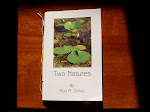
Chapbook: Two Natures

The Neville Museum series has published a chapbook of 15 of my poems. They are of human and spiritual natures. Here are two poems from the book:

Two Natures

On still water of the pond
two natures you may notice--
where scum has been gathering,
there also grows the lotus.

One Way

There's a boy
who stands knee-high
to a July cornstalk.
He stares one way
down the dirt road
his mother has gone.
He find Fortune
has desrted him,
like the poverty-stricken,
society-forbidden parent.
"I can't take care of you," she said.
I am the child who mirrors
his mother's tears without knowing why?